There are probably forty travel booking websites that all claim to show you the best prices. Most of them are searching the same inventory and presenting it slightly differently. A few are genuinely useful for specific things that others don’t do well. The rest you can ignore without missing anything.
Here’s what I actually use, and why.
Google Flights and Google Hotels: Start Here for Everything
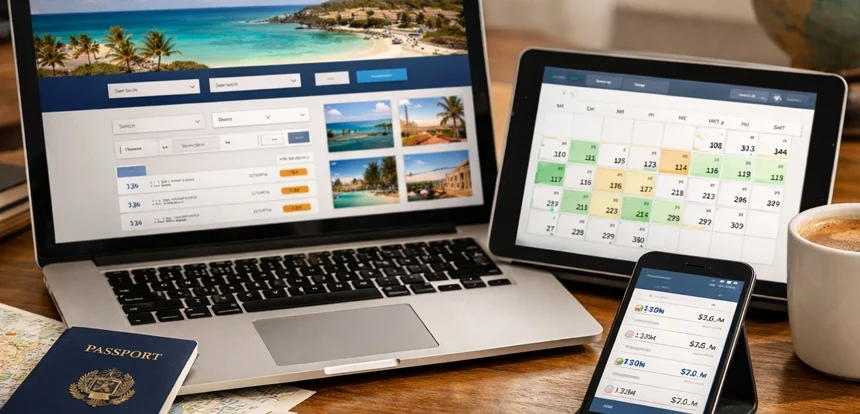
For flights, Google Flights is the best starting point for most searches. The price calendar shows you the cheapest days to fly at a glance, the Explore map shows cheap destinations from your home airport, and the fare tracking alerts you when prices change on a specific route. It doesn’t book flights directly, but it links you to the airline or booking site with the best fare without taking a commission that would inflate the price.
Google Hotels does the same thing for accommodation. It pulls rates from Booking.com, Expedia, Hotels.com, and the hotel’s own site simultaneously, shows the total price including fees, and lets you compare across all of them in one view. It’s the most honest hotel comparison tool available because it has no reason to steer you toward one platform over another.
These two tools alone cover the majority of what most travelers need. Everything else is for specific situations where they fall short.
Skyscanner for Open-Destination Searches
Type “Everywhere” as your destination on Skyscanner and it shows you the cheapest flights from your home airport to every place it has data for, sorted by price. Also useful: the “Cheapest Month” view, which shows you the cheapest weeks to fly a specific route across an entire year. If your question is “where can I go for under $400” rather than “how much does it cost to get to Rome,” Skyscanner is better suited to answering it than Google Flights.
Kayak for Complex Itineraries
Kayak’s “Hacker Fares” combine two one-way tickets on different airlines when the combination is cheaper than a round trip on a single carrier. It also handles multi-city searches cleanly, which Google Flights is less elegant about. The price forecast feature (buy now or wait) works reasonably well for popular routes with enough historical data. For a straightforward round trip on a common route, Google Flights usually gets there first. For anything more complicated, Kayak is worth a check.
Hopper for Flight Timing Decisions
Hopper’s main feature is a price prediction that tells you whether fares for a specific route are likely to go up or down, and when to buy. It’s more useful for trips booked several months out on routes with enough price history for the model to work. For last-minute bookings or unusual routes, it has less to work with. For planning a summer trip in February or March, it’s a genuinely useful data point.
Booking.com and Hotels.com for Accommodation
Booking.com has the largest global inventory of any single hotel platform, including a lot of smaller independent properties that don’t list on American-facing sites. Its “free cancellation” filter is among the most reliable of any booking site, making it useful for trips where plans might change. The interface is a bit overwhelming at first but the filter options are thorough.
Hotels.com runs a rewards program where every ten nights you book earn one free night at the average rate of the previous ten. For frequent travelers who stay at a variety of properties, this accumulates faster than airline loyalty points. The inventory largely overlaps with Booking.com; the choice between them often comes down to which has the better rate on a specific property.
In both cases: always cross-check the rate against the hotel’s own website before booking. Hotels are required by their own policies to offer a competitive direct-booking rate, and sometimes the direct rate is lower or comes with perks the third-party booking doesn’t include.
Airbnb and Vrbo for Rentals
Airbnb has the larger inventory and more variety, from shared rooms to full villas. Vrbo focuses on whole-property rentals and tends to have a higher concentration of family-oriented properties with proper bedrooms rather than studio conversions. For a family trip where you need multiple bedrooms and a kitchen, both are worth checking for the same dates to see which has better availability and pricing. Booking.com now includes vacation rentals in its listings too, which occasionally surfaces properties at lower prices than either platform.
Rome2rio for Getting Between Places
Rome2rio shows every option for getting from point A to point B: flights, trains, buses, ferries, and combinations of the above, with estimated prices and journey times for all of them. In Europe especially, the train is often faster, cheaper, and more pleasant than a budget airline once you factor in airport time. Rome2rio makes this comparison obvious. It doesn’t book most of these directly, but it tells you exactly what you’re choosing between.
What to Skip
Priceline’s name-your-price and Hotwire’s blind booking, where you commit to a hotel without knowing which one until after you pay, were compelling when the discount was significant enough to justify the uncertainty. Transparent pricing on all the other platforms has mostly closed that gap. The discount no longer justifies the gamble for most travelers.
TripAdvisor is excellent for reading hotel and restaurant reviews. It’s not a useful booking tool. Use it for research, then book elsewhere.
The goal with any of these is to spend ten minutes checking two or three sources rather than trusting that any one site has the best price. The site with the best price on any given search changes often enough that checking is always worth the few minutes it takes.
For airline consumer protections across any booking site, see the DOT's Aviation Consumer Protection office.