Rome does something to your perception of time almost immediately. You’ll walk past a 2,000-year-old aqueduct fragment holding up a neighborhood apartment building, or notice Roman column capitals repurposed as a church doorway, and your sense of what counts as old recalibrates entirely. The city is overwhelming in that specific way, and most of what makes it overwhelming is free.
The First Sunday Changes Everything
Italy’s Ministry of Culture designates the first Sunday of every month as free admission day at all state-run museums and archaeological sites. This includes the Colosseum complex, covering the Colosseum itself, the Roman Forum, and the Palatine Hill, a combination that normally runs around €18 per person. For a family of four, planning a first-Sunday visit saves €72 in a single afternoon.
The trade-off is lines. Arrive before the Colosseum opens (9am most of the year) for any reasonable chance of getting in without a long wait. The Romans who know this policy show up at 7:30. Getting there at 8:30 positions you well. The wait is worth it; the Colosseum on an early-entry crowd is a different experience from the midday surge of tour groups.
Fountains, Piazzas, and Things That Don’t Have Doors
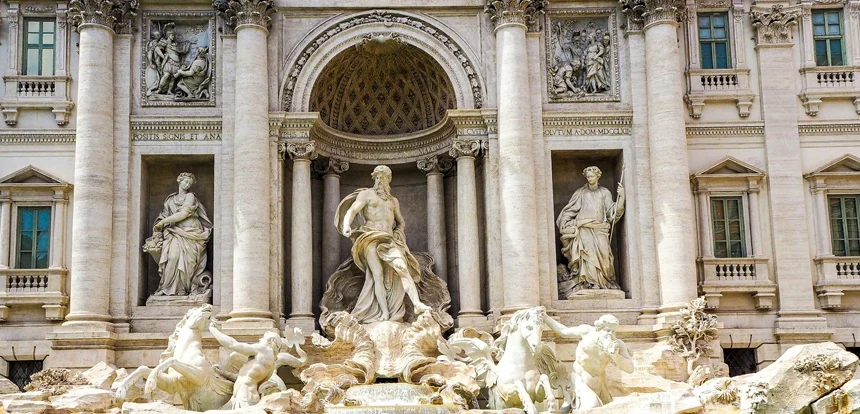
The Trevi Fountain is free. The best time to see it is before the crowds arrive, seven in the morning, when the light comes in at a low angle and the tour groups are still at breakfast. That version of the Trevi is worth the early start. By 10am it belongs largely to Instagram.
Piazza Navona contains Bernini’s Fountain of the Four Rivers, one of the finest pieces of public sculpture in Europe, in a piazza that costs nothing to stand in. The Spanish Steps are free. Piazza del Popolo, with two matching Baroque churches flanking the main gate into the old city, is free. These aren’t backup plans or cheap alternatives to the real attractions. They’re part of what makes Rome exceptional.
The Aventine Hill Keyhole
There’s a detail most guidebooks mention that sounds implausible until you see it. The gate to the Priory of the Knights of Malta on the Aventine Hill has a keyhole. Through that keyhole, framed by the hedged garden inside, the dome of St. Peter’s Basilica appears perfectly centered at the end of the alignment, seemingly floating in the distance. It’s precise, extraordinary, and free at any hour. Most tourists walk past the hill entirely.
The Church Door Strategy
Rome has roughly 900 churches. Most are free to enter. Many contain masterpieces that would draw paying crowds in any dedicated museum. The Basilica di Santa Maria Maggiore is vast and free. Santa Maria sopra Minerva has a Michelangelo sculpture inside and almost no one queued to see it. San Luigi dei Francesi has three Caravaggio paintings in the left transept, arrive when the light is good, drop a euro in the illumination box if you want to see them properly, and spend 20 minutes with paintings that belong on any list of the best things in the city.
An afternoon of walking from church to church in Rome costs almost nothing and returns more art per hour than most museum visits. You just have to know to look for it.
The Vatican Is Two Different Experiences
St. Peter’s Basilica is free to enter. The Vatican Museums, which include the Sistine Chapel, are not — €20 or more per person, considerably more with a guide. The last Sunday of every month, Vatican Museums are free, but the line starts forming before 7am for a 9am opening. If you’re planning around that policy, go prepared.
What’s often missed: the Basilica itself contains Michelangelo’s Pietà, Bernini’s bronze canopy over the main altar, and dozens of other significant works, all accessible without a ticket. St. Peter’s Square, the twin curved colonnades that Bernini designed as arms outstretched to welcome visitors, is always free. The walk along the Tiber toward the Vatican through the Borgo neighborhood costs nothing.
Trastevere and the Rome Worth Walking
Trastevere on a Sunday morning is its own reward. Cobblestone streets, ivy-covered buildings, the neighborhood quiet before the day starts. The Basilica of Santa Maria in Trastevere is one of Rome’s oldest churches, free to enter, with Byzantine mosaic work that predates most European cathedrals. Campo de’ Fiori, a 10-minute walk away, has a morning market that’s free to walk through and a complicated history. Giordano Bruno was burned for heresy in the square’s center in 1600, a fact the statue of him makes clear.
Rome has been accumulating things worth seeing for more than two millennia, and the city hasn’t managed to put entrance fees on most of them. The outdoor life of the city, the piazzas, the fountains, the hills, the streets themselves, is the city at full scale. The museums are, mostly, extra. If Paris is next on the itinerary, the same principle applies — most of what makes it remarkable is also free. We’ve covered the best free things to do in Paris in a separate guide.
For Rome’s official free museum days and state-site schedules, see Italy's official tourism portal.