For a long time, my travel fund was the money left over after everything else. Which meant my travel fund was zero most months, and “someday” stayed exactly as far away as it always had.
The problem isn’t willpower. It’s structure. If travel money lives in the same account as rent and groceries and the occasional impulse buy, it doesn’t stand a chance. The trick is creating the conditions where saving happens automatically, before you can make a different decision. Six months is a realistic horizon for most people to fund a meaningful trip. Here’s what actually works.
Start With a Real Number, Not a Feeling
“I want to travel more” is not a plan. “I need $2,800 for flights, accommodation, and spending money for a week in Portugal in October” is a plan. The specificity matters, because it gives you a target and a deadline to work backward from.
Pick a destination. Look up the actual costs. Add 15% for things you’ll underestimate. Now you have a number. $2,800 over six months is roughly $470 a month, or about $110 a week. That’s a different conversation than “I should save more.” It’s a specific thing to either do or not do.
The Separate Account Rule
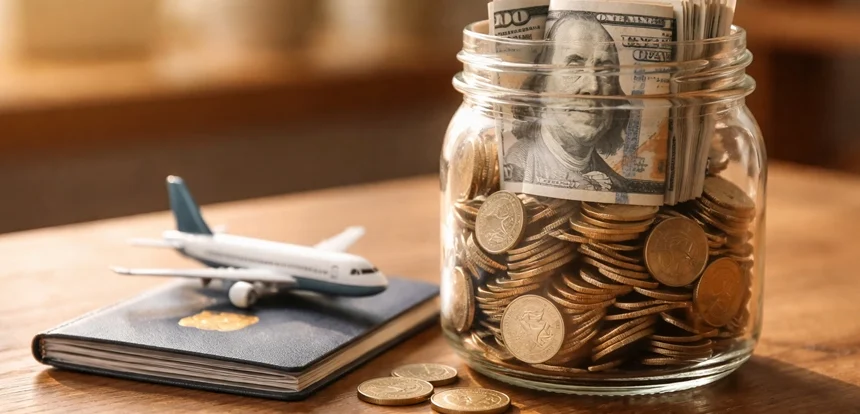
Not a mental category. Not a sub-account at your current bank. A separate, named account at a different institution, ideally one with a decent interest rate on savings. Online banks currently offer rates that at least partially offset inflation, and the friction of moving money out of them is a feature, not a bug. When your travel fund is two clicks from your spending money, you’ll spend it. When it requires a transfer to a different institution, you probably won’t.
Name the account something specific: “Portugal October” or “Family Mexico 2027.” A named account with a visible balance is more motivating than a number labeled “savings.” You’re not watching a bank balance grow. You’re watching the trip become real.
Automate It Before You Can Think About It
Set a recurring transfer on the same day your paycheck lands. Not a few days later when you’ve already started spending. The same day, automatically. Even a small number. Seventy-five dollars a week is $1,950 over six months. A hundred a week is $2,600. The exact amount matters less than the automaticity. You want the decision made once, executed on its own.
This is what “pay yourself first” actually means in practice. You’re not setting aside whatever’s left. You’re moving the trip money before the rest of the month has a chance to absorb it.
Find Your $100-a-Month Habit
Almost everyone has one. A streaming service they open maybe twice a month. A gym membership that’s been on autodraft since January of the previous year. A food delivery habit that feels like a convenience but functions as a premium. I’m not suggesting you give up things you value. But there’s usually something that doesn’t actually deliver what it costs, and that thing, redirected, is $100 a month toward the travel fund without any other sacrifice.
$100 a month is $600 over six months. Paired with the automatic transfer, you’re most of the way there before anything dramatic has happened.
Redirect Windfalls the Moment They Arrive
Tax refunds, bonuses, birthday money, whatever shows up that wasn’t in the regular budget. The risk with a windfall is that it disappears into ordinary spending before you’ve decided to keep it. “I’ll move some of it this weekend” becomes “I’ll start fresh next month.” Don’t give it that chance. Transfer it to the travel account the day it arrives, then decide how much, if any, to move back.
Selling things you don’t use works faster than most people expect. I once funded a meaningful chunk of a trip to Iceland by selling camera equipment I’d upgraded away from and a collection of things from a storage unit I’d been paying to ignore. One Saturday.
The One-Weekend-a-Month Rule
Pick one weekend a month and just don’t spend money on it. Cook from what’s already in the kitchen, stay home, skip the shopping. Not because it’s a moral stance, just as a practical move. The savings from a single no-spend weekend in a month, multiplied by six, are real. It’s also a useful reset for noticing which spending was habitual rather than chosen.
Track It Like It Matters
Check the balance once a week. Progress is what keeps you from dipping into it when something tempting comes up. Watching the number grow is genuinely motivating in a way that vague intentions aren’t. Notice the milestones. Halfway there means you’ve proven you can do it. At three-quarters, the trip stops being an idea and starts being something you’re actually going to.
The moment I realized I’d always been walking past the travel fund I wanted, just without a separate container to put it in, was the moment the whole thing got considerably easier. The money was almost always there. I just needed to stop letting it be invisible.
For the federal tools on saving and compound interest, see the CFPB's consumer savings tools.