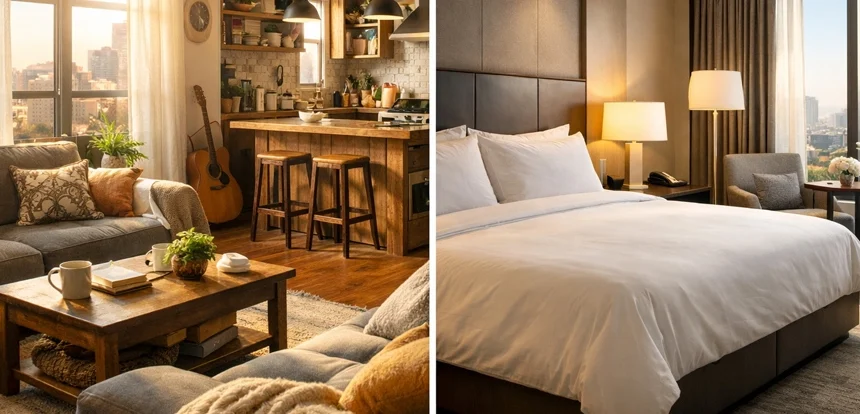
Airbnb is almost always cheaper than a hotel. Everyone knows this. Except it’s often not, and the way you find out is when you’re on the checkout page and the cleaning fee is $175. By that point you’re already emotionally committed to the listing.
Both sides of this debate have their partisans. The truth is messier and more situational than either camp admits, and the only way to actually know which is cheaper is to do the math on a specific trip. Here’s how to do that math, and when each option wins.
What Airbnb Is Actually Charging You
The nightly rate you see in the search results is rarely what you pay. By the time you get to checkout, you’ll see a cleaning fee (often $80-$200 for a full property, regardless of how long you stay), a service fee (Airbnb’s cut, typically 14-16% of the total), and local taxes on top of everything.
For a one-night stay, a cleaning fee of $150 on a property listed at $100/night means you’re paying $250 before taxes and service fees. The same city might have a hotel at $140/night with nothing added but a $20 resort fee. The hotel wins by a lot. The listing that looked 40% cheaper wasn’t.
The cleaning fee problem is specifically a short-stay problem. It gets divided across however many nights you’re there. Two nights: $75 extra per night. Six nights: $25 extra per night. Length of stay matters enormously in Airbnb math.
What Hotels Are Actually Charging You
Hotels have their own fee problem, documented in more detail than I’ll repeat here. Resort fees at beach and city hotels can run $25-$50 per night, mandatory. Parking is often $30-$60 in urban markets. WiFi can still cost money at older business hotels.
What hotels generally don’t charge: a cleaning fee per stay, a service fee percentage of your total, or a fee for having different guests than the previous night. The fees they do charge are more visible in some booking engines now, and for loyalty members, several (parking, amenity access, Wi-Fi) often disappear.
When Airbnb Wins
Long stays. Five or more nights is the point where cleaning fees amortize into something reasonable and you start to benefit from having a kitchen. Cooking even half your meals instead of eating out is real savings that don’t show up in the accommodation comparison but absolutely show up in your total trip budget.
Groups and families. One Airbnb with three bedrooms beats three hotel rooms nearly every time. The shared living space, the kitchen, the ability to put kids to bed while adults stay up: all of this has genuine value that doesn’t appear in a price comparison but makes the trip better and cheaper.
Destinations where the Airbnb inventory is genuinely local, meaning actual apartments and homes rather than professionally managed short-term rental operations. In some markets this is the norm. In others, most Airbnb listings are functionally hotel rooms managed by a property company, which removes most of the advantages while adding the cleaning fees.
When Hotels Win
Short stays. One or two nights in a city almost always favors hotels, especially once you add the cleaning fee. You also don’t need to coordinate key pickup, manage check-in logistics, or figure out the quirks of someone else’s kitchen at midnight after a flight.
Solo travelers and couples who only need one room. The hotel room isn’t inefficient for you. And hotel loyalty programs generate real value over time, particularly if you travel for work and accumulate nights quickly.
Urban destinations where the hotel market is competitive. Major cities in the US, UK, and parts of Europe have enough hotel inventory at enough price points that a decent option often beats comparable Airbnb listings on total cost, especially mid-week.
The Math on a 4-Night Family Trip
Family of four, four nights. The Airbnb: $130/night, $160 cleaning fee, 15% service fee, plus tax. Total: roughly $820 before local taxes. A two-room hotel suite or a connecting room pair at $140/night per room: $1,120 before taxes, but includes daily housekeeping, a pool, breakfast if it’s included, and no checkout logistics. The family Airbnb still wins here, but not by $50/night. The real margin is closer to $300 for the stay.
Change the stay to two nights and the Airbnb total is around $480 for the same property. The hotel drops to $560. Now you’re saving $80 total, and a hotel with a complimentary breakfast erases even that.
The Option Everyone Overlooks
Vrbo and direct booking through vacation rental agencies often list the same or similar properties without Airbnb’s service fee. Some hosts list on multiple platforms and will take a direct booking at a lower price. Asking never hurts. Neither does checking Vrbo before assuming Airbnb is your only short-term rental option. In some markets the difference is 15-20% on the total cost.
I’ve stayed in hotels that felt like a great deal and Airbnbs I’d happily book again. I’ve also done the reverse. The assumption in either direction is where the money goes. Check both, do the actual math every time, and neither platform will disappoint you as often.
For the rules on how hotels and rentals are required to disclose pricing, see the FTC's junk fees rule.